
The Biodegradable Bottle Trap
Good for the planet. Potentially worse for you. Here is what the science actually says.
They are everywhere now. Walk through any natural food store, browse any health-forward supplement brand, and you will find them: bottles proudly labeled biodegradable, compostable, eco-friendly, plant-based. The packaging feels different — lighter, slightly textured, morally satisfying in a way that conventional plastic never was. The message is clear. You are making a better choice. You are part of the solution.
The problem is that the science is pointing in a different direction. Not about what these bottles do to the planet — that story is complicated enough — but about what they may be doing to you. The biodegradable bottle revolution, marketed entirely on the premise of environmental responsibility, has arrived ahead of the health research that would tell us whether its trade-offs are acceptable. That research is now catching up. What it is finding deserves your attention before you open your next supplement.
The Core Problem
Biodegradable does not mean safe. It means the plastic breaks down — but where it breaks down, under what conditions, and into what determines whether that breakdown is better or worse than conventional plastic sitting inert in a landfill. For two of the most common biodegradable bottle technologies, the breakdown process produces microplastics that may be more toxic, more biologically penetrating, and more neurologically harmful than the conventional plastics they replaced.
Oxo-Degradable Bottles: Microplastics on Demand
The most common biodegradable bottle in the current supplement market is not actually a new material at all. Oxo-degradable plastic is conventional petroleum-based plastic — usually HDPE or PET — with pro-oxidant additives mixed in that cause it to fragment faster when exposed to heat, UV light, or oxygen. The marketing says it breaks down. The science says it breaks into pieces.
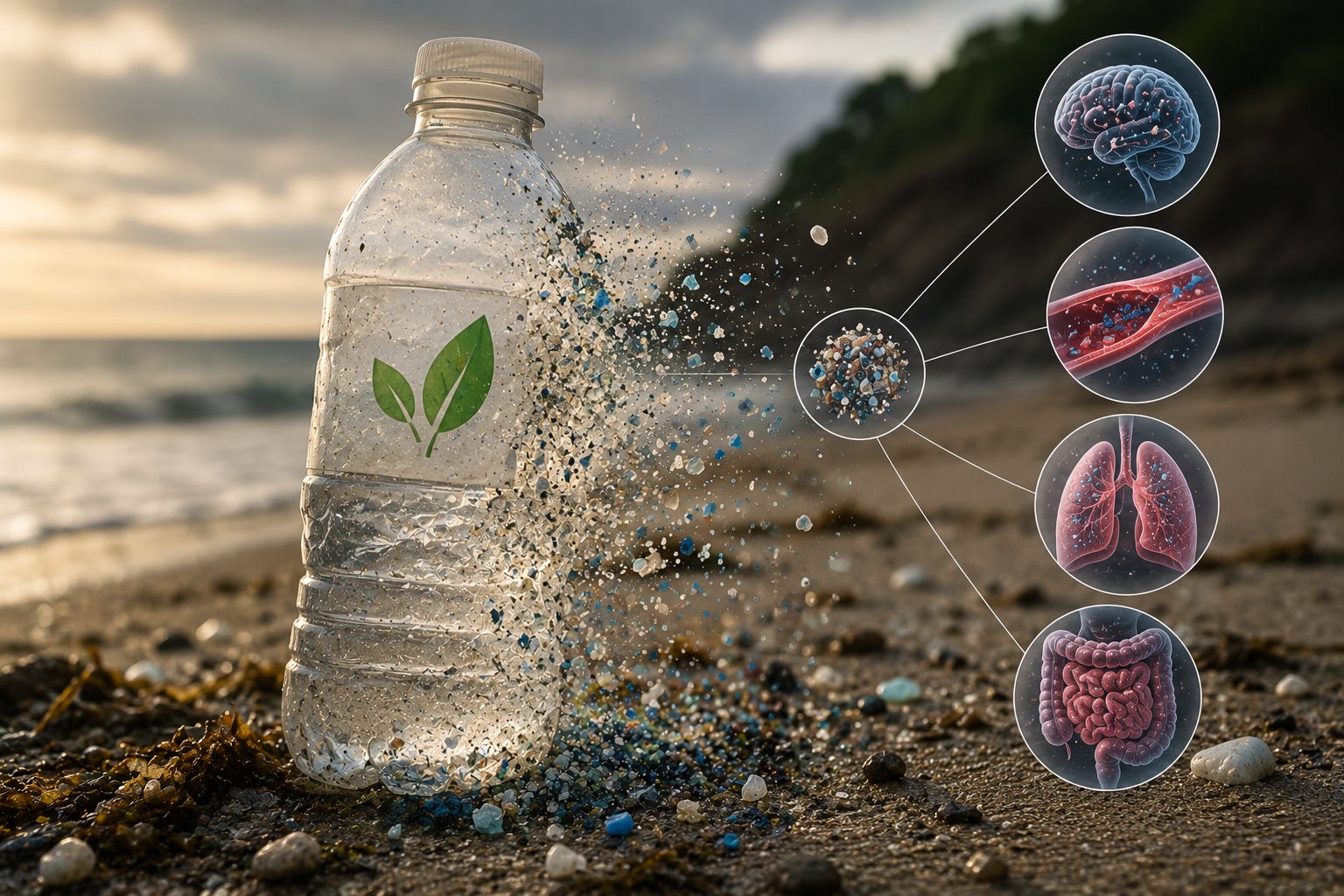
That distinction is everything. A conventional plastic bottle sitting in a landfill takes decades to fragment into microplastics. An oxo-degradable bottle is specifically engineered to fragment faster — producing more microplastics, sooner, often in smaller particle sizes than conventional plastic generates. Smaller particles are the problem: nanoplastics under 100 nanometers in diameter cross biological barriers that larger particles cannot. They cross the gut wall. They cross the blood-brain barrier. They are found in arterial plaque at levels that correlate with significantly elevated cardiovascular event risk.
The European Union reviewed the evidence and banned oxo-degradable plastics in 2021 as part of its Single-Use Plastics Directive — not because they were no different from conventional plastic, but because they were potentially worse. A 2025 critical analysis published in a peer-reviewed journal reviewed the literature between 2020 and 2025 and concluded that oxo-biodegradable polymers do not result in complete biodegradation, that the formation of microplastics is evident, and that these materials promote environmental misinformation and greenwashing practices. They are still legal and actively marketed in the United States.
What You Are Buying
An oxo-degradable supplement bottle is a conventional petroleum-based plastic engineered to produce microplastics faster than a standard bottle — sold at a premium with environmental claims that the EU has explicitly rejected. The additive that makes it degrade is present throughout the material and in contact with your supplement from the moment of manufacture.
PLA Bottles: The Plant-Based Problem
The second major biodegradable bottle technology is PLA — polylactic acid — derived from fermented plant starches, most commonly corn or sugarcane. PLA is genuinely bio-based, which is a meaningful distinction from petroleum plastics. Under the right conditions it can genuinely biodegrade. Those conditions are a composting facility operating above 58°C with specific microbial populations — not a recycling bin, not a landfill, and certainly not the inside of a supplement cabinet.
In any environment other than industrial composting, PLA behaves like conventional plastic. It persists. It fragments. And when it does, the 2024 research suggests the fragments it produces may be more biologically harmful than those from conventional plastic — not less.
The 2024 Finding That Changes Everything
A study published in Advanced Science in 2024 by Huang and colleagues investigated what happens when PLA microplastics enter the gastrointestinal tract — which is exactly what happens when your supplement bottle sheds particles into your capsules or powder. The finding was stark: PLA microplastics undergo incomplete degradation in the gut, and that incomplete degradation transforms PLA polymer fragments into oligomer nanoplastics. The researchers’ own words: “Oligomer microplastics exhibit greater cell toxicity than polymer microplastics of the same size, indicating that the transformation into oligomers during incomplete degradation further enhances PLA toxicity.”
The study documented neurotoxic effects — damage to neural tissue — from the oligomer nanoplastics produced when PLA degrades inside the body. The biodegradation that was supposed to be the feature is the mechanism of harm. The plant-based plastic that was marketed as safe because it breaks down is breaking down inside the human gut into particles that are more toxic at the cellular level than the conventional plastic particles it was designed to replace.
The Mechanism
PLA enters the gut as a microplastic particle. Gut acids and enzymes begin degrading it — incompletely. The partial degradation produces oligomer nanoplastics that are smaller, more bioavailable, and more cytotoxic than the original particle. Rising rates of gastrointestinal illness including colon cancer in younger age groups have been loosely linked in the scientific literature to the ubiquity of microplastics. PLA adds a degradation pathway that conventional plastics do not have — one that produces more harmful particles in the one location where supplements are intended to do their work.
The Marketing Gap
The biodegradable bottle market exists because consumers are paying attention to plastic pollution and responding to it. That attention is legitimate. Plastic pollution is a genuine environmental crisis. The supplement brands adopting biodegradable packaging are, in many cases, acting in genuine good faith — responding to consumer concern with the available options. The problem is that the consumer concern that drove the adoption was focused on the environment, and the health research on these materials is newer, less visible, and reaching a different conclusion.
A 2025 review in a peer-reviewed journal described the oxo-degradable category explicitly as promoting environmental misinformation and favoring greenwashing practices. The Ellen MacArthur Foundation, PepsiCo, Unilever, and the WWF all signed a 2017 report calling for the ban of oxo-degradable plastic packaging. The EU acted on that recommendation in 2021. In the US supplement market in 2025, the same material is being sold with leaf graphics and the word sustainable on the label.
No supplement brand is required to test its packaging for microplastic leaching into the product. No regulatory body currently requires microplastic disclosure on supplement labels. The consumer reaching for the biodegradable bottle because it seems like the healthier choice has no mechanism to know that the science currently suggests the opposite may be true.
The Question to Ask
Before purchasing any supplement in biodegradable packaging, ask the manufacturer: Is this bottle oxo-degradable or PLA? Has the packaging been tested for microplastic migration into the product? Is the bottle certified for industrial composting, and is a certified facility accessible to your customers? A company that cannot answer these questions has not thought through the implications of its packaging choice beyond the marketing layer.
What to Do Instead
The honest answer is that the cleanest supplement packaging available today is the same one it has always been: amber glass. Chemically inert, microplastic-free, UV-protective, infinitely recyclable, reusable, and producing no particles of any kind under any storage condition. Its trade-offs — higher shipping cost, heavier weight, breakage risk — are real and practical. They are not health trade-offs. Every trade-off in the biodegradable bottle story is a health trade-off disguised as an environmental one.
If glass is not available, HDPE Type 2 is the most stable and least reactive conventional plastic for supplement use — lower microplastic generation than PET under normal conditions, BPA-free, and widely recycled. It does not carry the enhanced toxicity profile that PLA’s gut-degradation pathway introduces, and it does not produce the accelerated microplastic fragmentation of oxo-degradable materials. It is unglamorous. It does not have a leaf on the label. Under current evidence, it is safer for the person opening it.
The Simple Rule
If a supplement bottle is labeled biodegradable, compostable, eco-friendly, or plant-based without specifying the material and its composting requirements — and without disclosing microplastic testing — assume it is either oxo-degradable or PLA. Ask before you assume the eco-label means what it sounds like it means. Your gut is where your supplements are supposed to work. It is not where you want to be generating oligomer nanoplastics from a bottle designed to break down.
Sources: Huang et al., Advanced Science (2024) — PLA gut degradation neurotoxicity; ScienceDirect (2025) — oxo-degradable microplastic review; Interference Journal (2025) — critical analysis of oxo-biodegradable plastics; EU Single-Use Plastics Directive (2021) — oxo-degradable ban; Advanced Science News (August 2024) — PLA hidden microplastic source. · For educational purposes only.
Nice article. I am happy someone is illuminating the fact that some of these environmental initiatives are not perfect in and of themselves.